
Research Highlights
Intelligent Operation of Integrated Electricity–Hydrogen–Transportation Energy Systems
March, 01, 2026
Overview
The transition to zero-emission transportation requires energy systems capable of coordinating multiple energy vectors and service demands in real time. Future charging and refuelling infrastructures must simultaneously manage renewable electricity, hydrogen production, energy storage, and dynamic vehicle demand under uncertain operating conditions.
System Framework
The study considers a multi-energy system integrating:
- Grid electricity supply and renewable generation,
- Battery energy storage,
- Hydrogen production and storage,
- Electric and hydrogen vehicle charging/refuelling infrastructure.
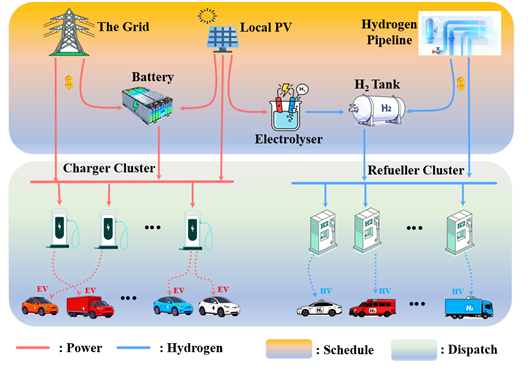
The system operates under time-varying energy supply, dynamic vehicle demand, and operational constraints, forming a complex environment for coordinated decision-making. The modelling framework captures interactions between energy flows, storage states, and service operations within a unified simulation environment.
Research Problem
This research investigates the intelligent operation of an integrated electricity–hydrogen–transportation energy system, where multiple operational tasks must be jointly optimized to ensure efficient, low-carbon, and reliable system performance. The study addresses a multi-task operational problem involving:
-
- Energy dispatch — coordinating electricity and hydrogen flows across renewable generation, storage, and conversion units,
- Vehicle scheduling — managing dynamic charging and refuelling services for electric and hydrogen vehicles.
Key Challenges
-
- Renewable generation is intermittent and uncertain,
- Energy storage and conversion processes are dynamically coupled,
- Vehicle arrivals and energy demands are stochastic,
- Energy management and service scheduling decisions interact with each other.
Traditional rule-based or single-objective optimization methods struggle to capture these nonlinear and time-dependent interactions. In particular, energy dispatch decisions influence vehicle service performance, while charging demand affects system energy states.
Approach
To address the coupled operational challenges, the research develops an intelligent control framework that learns coordinated operational policies for multiple system tasks.
The study explores:
-
- Data-driven system modelling of energy and service dynamics
- Multi-objective optimization of dispatch and scheduling decisions
- Learning-based decision-making methods for adaptive system operation
A multi-agent learning framework is investigated, where different decision components focus on energy management and vehicle service scheduling, while learning to coordinate system-wide objectives such as cost efficiency, carbon reduction, and service performance. The approach enables adaptive operation under uncertain energy supply and demand conditions without relying on fixed rule-based strategies.
Expected Impact
The research aims to:
-
- Improve efficiency of integrated multi-energy systems
- Enhance renewable energy utilization and reduce carbon emissions
- Improve charging and refuelling service quality
- Enable intelligent coordination across electricity, hydrogen, and transport infrastructures
- Support resilient zero-emission mobility systems
The outcomes provide insights for designing future zero-emission energy and transport infrastructures and contribute to the development of resilient urban energy systems and sustainable mobility solutions.
Summary
This research investigates the intelligent operation of integrated electricity–hydrogen–transportation energy systems that support electric and hydrogen vehicles. It addresses a coupled multi-task problem involving energy dispatch and vehicle scheduling under uncertain energy supply and dynamic demand. The study explores learning-based coordination strategies to improve system efficiency, reduce carbon emissions, and enhance service performance in future zero-emission energy infrastructures.
Team Members
Fulong Yao (Postdoc)
Cardiff University

Yiming Xu (Postdoc)
Cardiff University

Maurizio Albano (Advisor)
Cardiff University

Liana Cipcigan (Advisor)
Cardiff University

Omer Rana (Advisor)
Cardiff University
Sign up for our mailing list
You’ll receive the latest updates on CLEETS research and programming.